 TRANSIT
Legal Arguments Against
the Orange Line Busway
The Metro G Line (Orange Line) was built on the Chandler Bikeway corridor not because it was the unanimous choice of transit planners, but because a combination of state law, political constraints, and legal battles foreclosed the alternatives. From the late 1990s through 2003, opponents of the BRT proposal filed a series of legal challenges arguing that the corridor should be used for light rail, that the Environmental Impact Report was inadequate, and that the LACMTA had failed to properly analyze rail alternatives. This page documents those arguments and their outcomes.
The Fundamental Legal Dispute
California Environmental Quality Act (CEQA) law requires that public agencies analyze a reasonable range of alternatives to a proposed project before approving it. When LACMTA approved the Orange Line BRT project in 2001, a coalition of rail advocates and Valley transportation organizations challenged the EIR on the grounds that LACMTA had not adequately analyzed light rail as an alternative.
The challengers' core argument was that the Chandler Blvd / former Southern Pacific right-of-way was wide enough to accommodate light rail—and had in fact been planned for light rail under Proposition A (1980) as a "starter line" candidate. Using it for BRT instead of light rail was, they argued, a downgrade that would permanently constrain the corridor's capacity.
The Proposition A Rail Designation
Proposition A (1980) and its companion planning documents designated the San Fernando Valley as one of several corridors to receive rail transit funded by the half-cent sales tax. The North Hollywood-to-Chatsworth alignment was among the identified corridors in regional transportation plans of the 1980s and early 1990s.
However, Proposition A funds came with a restriction that would prove decisive: state legislation prohibited the use of Prop A rail funds for subway construction west of Western Avenue in Los Angeles due to methane gas concerns (the same restriction that prevented the "subway to the sea" on Wilshire). The Valley corridor was not itself subject to this restriction, but the political environment created by the Wilshire subway controversy—combined with the escalating costs of the Red Line—shifted LACMTA's Board toward surface transit options for new corridors.
Key Legal Arguments Filed Against the BRT
The legal challenges against the Orange Line EIR focused on several distinct claims:
1. Inadequate Alternatives Analysis
CEQA requires agencies to analyze a reasonable range of project alternatives, including alternatives that might be environmentally superior. Challengers argued that LACMTA's EIR evaluated only a narrow set of BRT variants and did not conduct a genuine analysis of the light rail alternative. The light rail option was included in the EIR but characterized as infeasible based on cost estimates that opponents argued were inflated and methodologically inconsistent.
2. Air Quality and Traffic Impact Underestimation
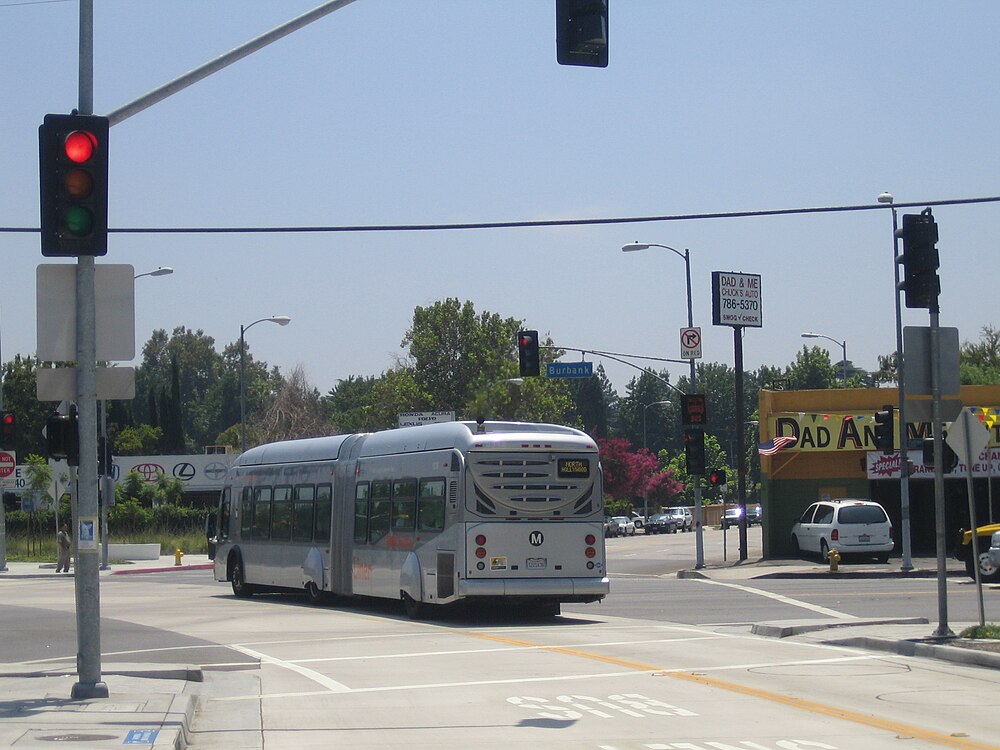
The EIR's traffic analysis was challenged for underestimating the number of at-grade crossings on the Chandler Blvd segment and the traffic signal preemption impact at those crossings. The Orange Line crosses 36 at-grade intersections between North Hollywood and Canoga. At each crossing, the BRT vehicle preempts the traffic signal, creating queuing on cross streets. Challengers argued the EIR did not adequately model the cumulative intersection delay impacts during peak periods.
3. Proposition A Consistency
Challengers argued that LACMTA's use of Proposition A transit funds for a BRT project on a corridor that had been designated for rail in the original Prop A planning documents was inconsistent with the measure's intent and potentially illegal. The argument was that the Board's implicit promise to Valley voters—that Prop A funds would deliver rail transit to the Valley—was being broken by substituting BRT.
4. State Rail Prohibition Misapplication
The legislation that prohibited rail in the Chandler corridor (AB 3 of 1998 and related legislation) was challenged on procedural and constitutional grounds by some parties, arguing that state preemption of local transit planning decisions exceeded the legislature's authority. This argument was largely unsuccessful in court but reflected the depth of frustration among rail advocates.
LACMTA's Defense of the BRT Decision
LACMTA's legal defense rested on several well-documented positions:
- State law compliance: Assembly Bill 3 (1998) explicitly prohibited LACMTA from using certain funds for rail construction in the Chandler corridor. The agency had no legal authority to build rail even if it had wanted to, given the available funding sources and legislative restrictions.
- Cost justification: LACMTA's cost estimates showed BRT at approximately $330 million versus light rail at $700+ million for the same corridor. Given the Red Line's cost escalation problems and the political environment around transit spending, the Board's selection of BRT was a reasonable exercise of its discretion.
- EIR adequacy: The agency maintained that the alternatives analysis met CEQA standards—the light rail alternative was analyzed, found to be more expensive and more complex to fund, and rejected on those grounds.
Court Rulings and Outcomes
The legal challenges against the Orange Line were ultimately unsuccessful. Los Angeles Superior Court and, on appeal, the California Court of Appeal upheld the EIR's adequacy, finding that LACMTA had analyzed a reasonable range of alternatives and that the BRT choice was within the agency's discretion. The courts declined to second-guess the agency's cost estimates or to require a more detailed light rail analysis.
Construction on the Orange Line began in 2003, and the line opened on schedule in October 2005. The legal challenges succeeded in extending the environmental review timeline but did not stop or modify the project.
Legacy of the Dispute
The legal battle over the Orange Line had lasting effects on LACMTA's planning practice. The agency adopted more comprehensive alternatives analysis procedures for subsequent BRT and light rail projects, and the controversy contributed to improved guidance from the California Attorney General's office on CEQA alternatives analysis for transit projects.
Whether the BRT-versus-rail decision was the right one remains contested among Valley transit advocates. The G Line has carried ridership above initial projections and has been a successful BRT corridor by most measures. However, the capacity constraints of the BRT platform are increasingly apparent as ridership has grown, and the question of converting the G Line to light rail—raised by advocates during the original legal challenge—periodically resurfaces in planning discussions.
The full context of how California's transit funding and legal framework shaped these decisions is covered in the Transportation 101 guide.
Frequently Asked Questions
Was the Chandler corridor originally designated for light rail?
Yes. Los Angeles County voters approved Proposition A in 1980, which included a light rail line in the San Fernando Valley along the Chandler right-of-way. The corridor was officially designated for rail in the Proposition A Long Range Transportation Plan. However, LACMTA later determined that BRT could be built for approximately $330 million compared to estimates of $700 million or more for light rail, and state legislation ultimately prohibited the use of rail-designated funds for rail construction in that corridor.
What legal arguments were made against the Orange Line busway?
Opponents filed a CEQA challenge arguing: (1) LACMTA's Environmental Impact Report inadequately analyzed light rail as a project alternative; (2) cost estimates comparing BRT and light rail were methodologically flawed; (3) using Proposition A funds for BRT on a corridor voters approved for rail violated the ballot measure's intent; and (4) the EIR failed to evaluate a "no project" alternative adequately. The lawsuit was filed in Los Angeles Superior Court in 2002.
What were the court rulings on the CEQA challenge to the Orange Line?
Both Los Angeles Superior Court and the California Court of Appeal ruled in favor of LACMTA. The courts found that the EIR analyzed a reasonable range of alternatives as required by CEQA, that the agency had discretion to select BRT over light rail based on cost and schedule, and that the Proposition A restrictions did not create a legal obligation to build light rail on the Chandler corridor. Construction began in 2003 and the Orange Line (now Metro G Line) opened on October 29, 2005.